
The evisa vs visa debate has one deciding factor: certainty. An e-visa is approved before you fly. You board knowing you are getting in. What is visa upon arrival? It is approval at the airport: queues, cash-only stamping fees, and a small but real chance of a problem at the worst possible moment.
Vietnam shows the difference. The e-visa costs $25 or $50, takes 3 to 5 working days, and works at 83 entry points including land borders. Visa on arrival needs an approval letter arranged in advance, works only at major airports, and adds a $25 or $50 stamping fee in cash on top. ETA vs e-visa: an ETA (like Kenya's eTA) is a lighter pre-screening, usually cheaper and faster than a full e-visa.
Count the routes before you debate them
The debate assumes both options are on the table. For a given passport, they usually are not. We classified every record in this site's collection, 439 destination-and-nationality pairs, by the entry route that record actually offers.
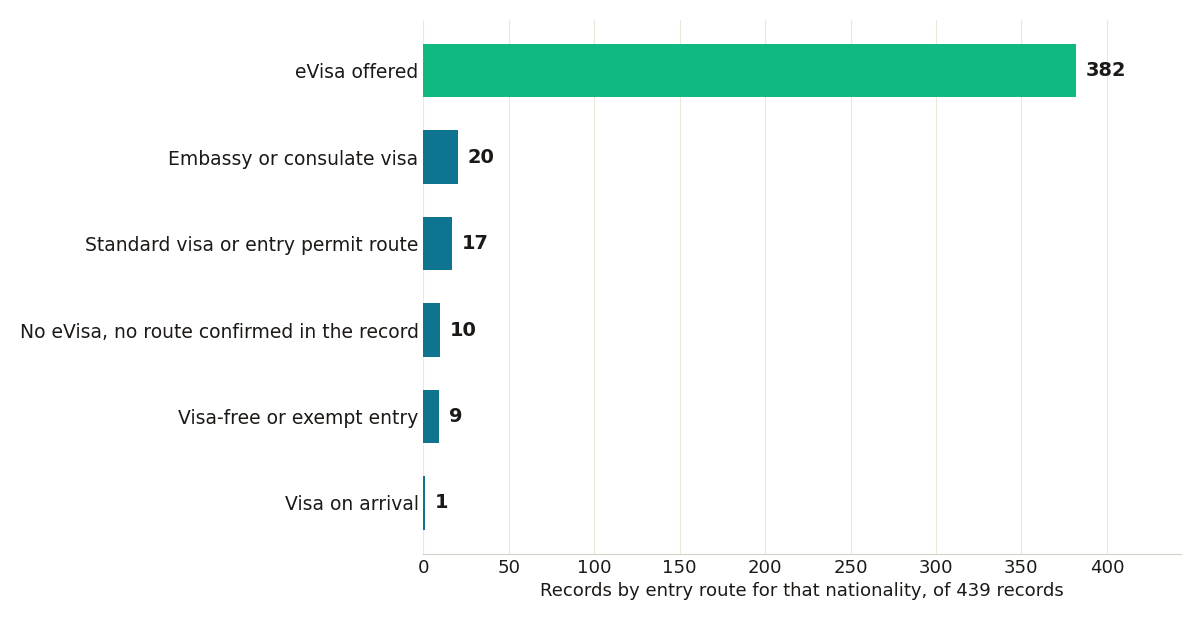

Source: EVisaDocuments collection via its public search index, harvested October 2026 (n = 439 records).
An eVisa is offered in 382 of the 439 records, about 87 percent. Embassy or consulate visas account for 20, and 17 records route the traveler to a standard non-electronic visa or a permit instead: Australia's Visitor visa subclass 600, New Zealand's standard Visitor Visa, Indonesia's regular visa for nationalities outside its e-VOA list, and Bhutan's entry permit for Indian nationals. Nine records need no visa at all, among them Cyprus and Ireland for exempt nationalities and Thailand for Indonesian travelers. Ten records confirm no route at all. And visa on arrival, the option half the internet argues about, appears exactly once as the stated route: Bhutan, for Bangladeshi nationals. A handful of destinations blur the categories, the Maldives records describe a free 30-day visa on arrival paired with an electronic traveller declaration filed before departure, but the shape of the data is not ambiguous.
The money argument runs the same way once the check is done. Where an eVisa exists it is usually the cheaper total: Vietnam charges $25 or $50 online and nothing at the border, while its visa on arrival stacks an approval letter fee on top of a $25 or $50 stamping fee paid in cash. Collection-wide, the median stated fee across the 199 records that publish a US dollar figure is $50, which buys certainty at roughly the price of the airport queue's surcharge. The honest exception is the 10 records that confirm no route at all, and the 20 that send you to an embassy or consulate: there, no software settles anything, and the correct output of a check is the words 'not confirmed, verify with the consulate', which the better tools are willing to say.
This is the actual job of visa check software: not to crown a winner between two products, but to tell you which route exists for your passport before you book around the wrong one. The order of operations is the whole game. Run the check first, while changing your mind is free. Book the flights second. Prepare the documents third, because the route decides the paperwork: the eVisa route in those 382 records comes with document lists that run to a median of four items, and the photo is on most of them.
That photo is the one piece of homework shared by almost every route, and it has to match the destination's spec rather than your last trip's. The free Visa Photo Maker on this site crops it to 51x51 mm for US and India visas, 35x45 mm for Schengen, UK, and Canada visas, and 33x48 mm for China visas, at the published pixel sizes and backgrounds. Pick visa on arrival only when the country offers no e-visa and you are comfortable with airport roulette. For everything else, the e-visa is cheaper in total, faster at the border, and lets you fix mistakes from your couch instead of an immigration hall. E-visa vs visa on arrival is a planning question: e-visas need lead time, VOA needs the right documents at the counter, and a two-minute check tells you which question you are actually answering. Sources: U.S. State Department