Almost every e-visa asks for the same core set. Gather these before you open any form:
- Passport valid at least 6 months beyond your travel dates, with blank pages.
- A recent digital photo: white background, no glasses, neutral expression. India wants a JPEG between 10 KB and 1 MB. Vietnam wants 4x6 cm.
- A color scan of the passport bio page, all corners visible.
- Flight details: arrival date, and for Vietnam, your exact entry port. E-visas there are port-specific.
- Accommodation details for at least the first nights.
- Proof of funds for some destinations, usually a recent bank statement.
- Travel insurance, mandatory for Schengen, smart everywhere else.
That is the core evisa documents list for most applications. Business e-visas add an invitation letter. The rest is country quirks, which is exactly what a checklist tool should tell you before you pay.
Counted honestly: how much paper is that per trip?
Checklists usually stop at the core set, so we counted the real lists in this site's collection: 401 destination-and-nationality records that state their required documents, out of 439 records covering 50 destination countries.
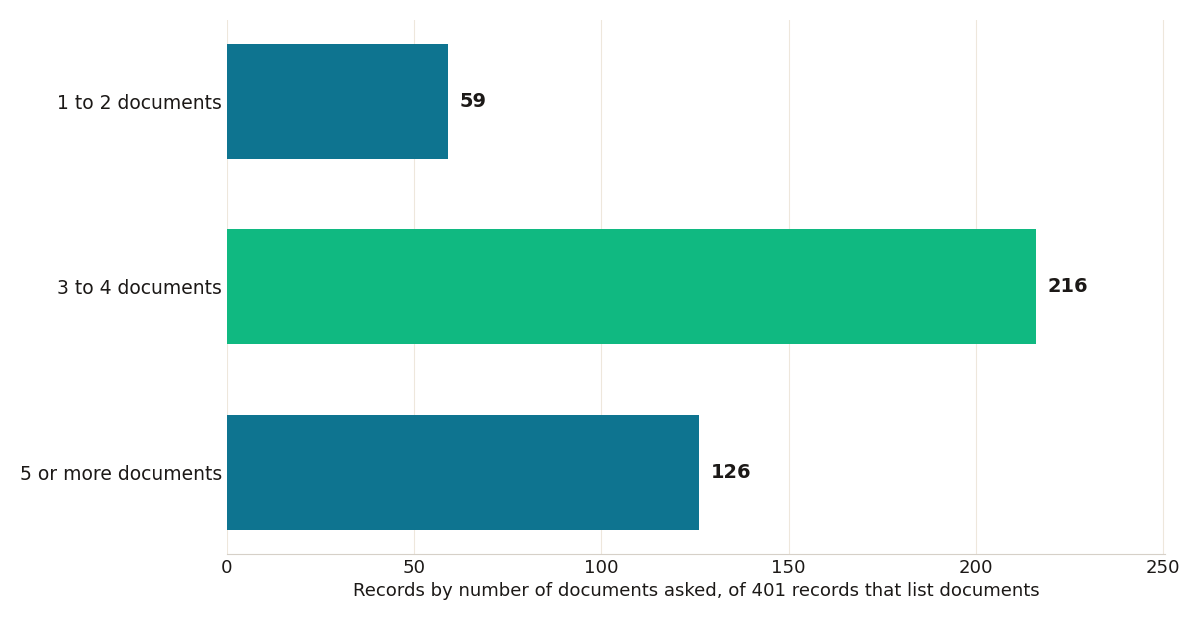

Source: EVisaDocuments collection via its public search index, harvested October 2026 (n = 401 records listing documents).
The median application asks for four documents. Only 59 of the 401 lists stop at one or two items, while 126 ask for five or more, which is why the seven-item core list above is a starting point and not a promise. The passport rule underneath all of it is just as consistent: 420 of the 439 records require a passport valid for 6 months, 11 require 12 months, and only 8 accept 3 months. A checklist that does not check the passport's expiry date first is not finished, whatever else it counts.
What pushes a list from four items to five or more is rarely exotic. Proof of funds appears in 79 of the 401 lists and travel or health insurance in 60, and both tend to arrive as late surprises because neither is a document travelers keep in the travel folder. An invitation or host letter appears in just 18 lists, and an address at the destination in 25, the kind of small item that stalls a form at midnight because the hotel confirmation is in somebody else's inbox. A payment card for the fee is itself listed in 83 records, a reminder that some portals treat the means of payment as part of the application pack. The long lists are not stricter countries being difficult; they are the same core set with the money, insurance, and host questions made explicit instead of sprung at the border.
A worked example shows the spread. Take the collection's shortest common pattern, Turkey: passport, payment card, email, three items, done in one sitting. Take Thailand: passport, photo, flights in and out, accommodation, and a funds figure written into the record itself, five items, two of which need a booking to exist before the visa does. Same traveler, same week, two different evenings of preparation. That gap, not the average, is what a checklist is for.
Why a real checklist starts with your passport, not the destination
The collection is organized the way the rules actually work: one record per destination and nationality pair. The same destination asks different travelers for different papers. Thailand asks most nationalities for five items including proof of funds set at THB 20,000 per person, and asks Indonesian travelers for nothing at all because they enter visa-free. Turkey asks for no photo and takes a payment card and an email address instead. Vietnam adds a temporary address and the exact ports of entry and exit. An immigration checklist app that starts with the destination and never asks who is traveling is averaging away the only variable that changes the answer.
The photo deserves its own line on any checklist: it appears in 265 of the 401 lists, at sizes that change by destination. The free Visa Photo Maker on this site sizes it correctly before you upload, with presets at 51x51 mm for US and India visas, 35x45 mm for Schengen, UK, and Canada visas, and 33x48 mm for China visas, exported at the pixel size and background each spec publishes. Scan your passport with a visa scan app before you start the form, size the photo with the maker, and the checklist is genuinely done rather than mostly done. Sources: U.S. State Department