
Vietnam: $25 single or $50 multiple, up to 90 days, 3 to 5 working days, official portal evisa.gov.vn, valid at 83 entry points. Pick your entry port carefully; the visa is port-specific. Beware copycat .com sites charging $80 plus.
Turkey: about $50 for Americans, as low as $20 for some nationalities, approved in minutes to 24 hours at evisa.gov.tr, 90 days within a 180-day window for US passport holders. Indians qualify only with a valid Schengen, US, UK, or Ireland visa.
Thailand: the e-visa exists at thaievisa.go.th with fees varying by consulate, but most tourists never need it. Thailand's 60-day visa exemption covers 93 nationalities, which makes the e-visa relevant mainly for longer stays and specific nationalities.
The big three, measured against the whole collection
Those three destinations anchor most evisa searches, so we priced them against our own collection: 439 destination-and-nationality records covering 50 destination countries and 11 traveler nationalities, pulled from this site's public search index. Vietnam and Turkey carry records for 10 of the 11 nationalities each, Thailand for 8, and every one of those records asks for a passport with 6 months of validity. On price, the records' own notes state the single-entry fees below, set against the median fee across the 199 records in the collection that state a US dollar figure.
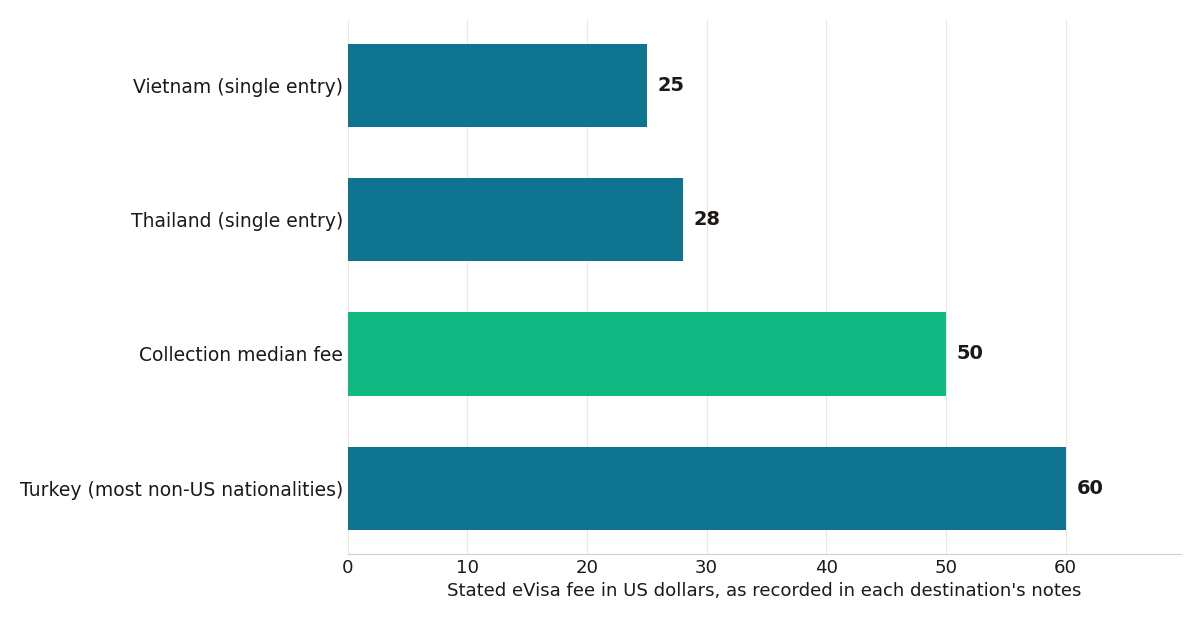
Source: EVisaDocuments collection via its public search index, harvested October 2026 (n = 199 records stating a fee; 439 records in total).

The paperwork count separates them more than the price does. Thailand asks for five items per record: passport bio page, a recent photo, flight confirmations in and out, accommodation proof, and proof of funds set at THB 20,000 per person. Vietnam asks for four: a passport data page scan, a 4x6 cm portrait photo on a white background, a temporary Vietnam address, and your travel dates and ports. Turkey asks for three, the shortest list of the three: a valid passport, a payment card, and an email address. Across all 401 records in the collection that list their documents, the median list runs to four items, so Vietnam sits exactly on the median, Thailand above it, and Turkey below it. Thailand is also the split case: 7 of its 8 records use the e-visa, while Indonesian travelers are recorded as visa-free instead, which is the exemption system doing the work for them.
The nationality fine print differs as much as the paperwork. Vietnam's records describe an e-visa open to all nationalities since December 2025, one rulebook for everyone in the collection. Thailand runs two systems side by side: the e-visa in its records, and the exemption that quietly handles most tourists before the e-visa ever comes up, with a multiple-entry tourist version at THB 5,000, valid 6 months at 60 days per visit, for travelers who come and go. Turkey splits the difference, with an e-visa whose supporting-document rules change by passport: the Indian records only work alongside a valid Schengen, US, UK, or Ireland visa or residence permit, which is why a fee comparison alone never settles a Turkey application.
Stay limits follow the same pattern of three different answers. Vietnam grants up to 90 days on the e-visa. Turkey works on a 90-days-in-180 window for the nationalities in its records. Thailand's single-entry e-visa is the short-stay product, while the longer pattern of visits belongs to the multiple-entry version. Travelers plan all three countries on the same Southeast Asia and stopover itineraries and assume the rules rhyme; the records say they share a product name and very little else.
The photo is where the three stop resembling each other
Vietnam wants a digital portrait at 4x6 cm with a white background. Thailand wants a recent photo, taken within the last 6 months per its records. Turkey wants no photo at all: every one of its 10 records states plainly that the application requires no photo upload. One product category, three different photo rules, and the photo is the requirement travelers most often get wrong because they assume the last country's rule carries over.
If your destination does want a photo, the free Visa Photo Maker on this site crops and sizes it to the spec before you upload: 51x51 mm for US and India visas, 35x45 mm for Schengen, UK, and Canada visas, and 33x48 mm for China visas, each exported at the published pixel size with the right background. It takes a minute, and it removes the single most common silent rejection in the e-visa world.
Three portals, three fee structures, three sets of traps. The common thread: every official portal is a government domain, every fee is non-refundable, and every rejection comes from details a checklist would have caught. Sources: U.S. State Department