
Your visa can be approved, your bag packed, and your trip still stopped by the other document. Passport validity is a separate check from visa validity, and it runs on its own clock: some countries want six months of it left when you arrive, some want three months left after you leave, and a few are happy with the length of your stay alone. This guide is the passport half of the fine print. The visa half, entry windows and how long you may stay, is covered in our guide to e-visa validity and stay duration.
Two documents, two clocks
A visa answers one question: are you allowed in, and for how long. A passport answers a different one: will this document still be valid on the dates the trip needs. A visa lives on its own clock. A passport lives on another. Neither expiry date protects the other. A ten year visa in a passport with four months left is a valid visa you may not be able to travel on, and a brand new passport does not rescue a visa that expired last spring.
Every country states the passport rule as a floor measured from a date in your trip: the day you apply, the day you arrive, the day you leave, or the end of your stay. The floor and the measuring date are the two things to check, in that order. There are four families of rule, and your nationality can move you between them.
Family one: the six-month rule
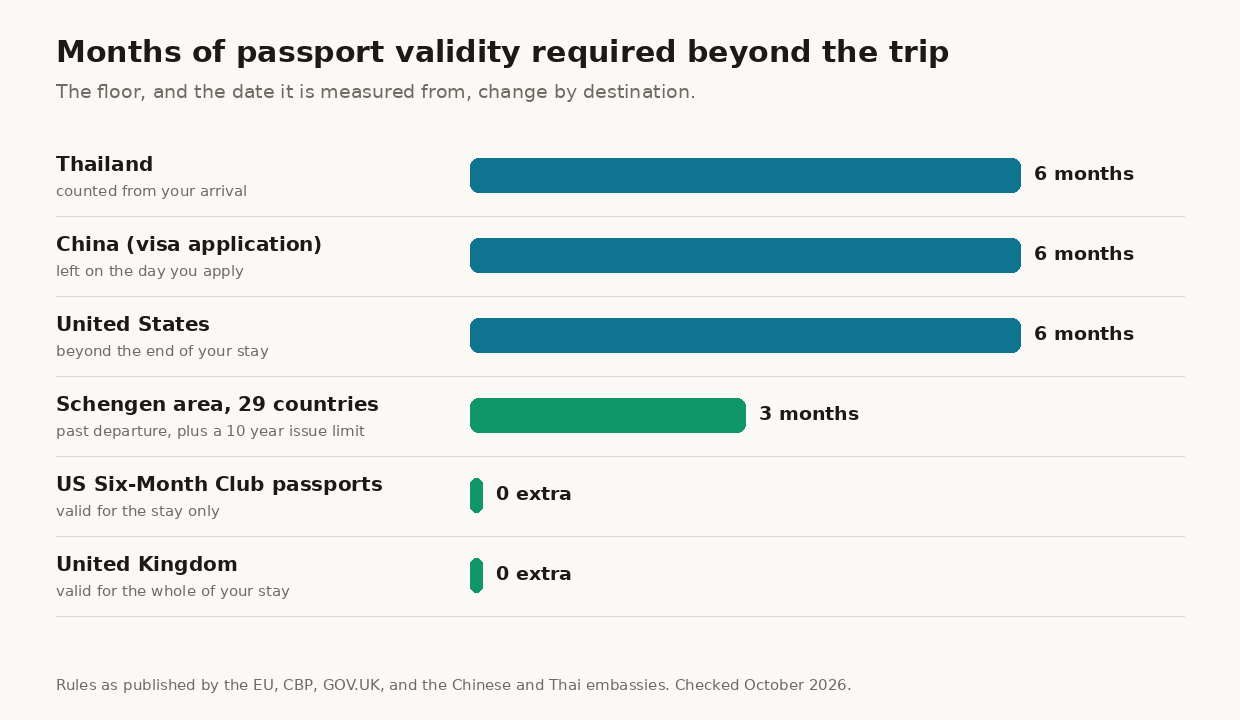
The strictest common rule asks for six months, but the measuring date changes the maths. China measures from the day you apply: the Embassy of China in the United States requires, for every visa category, a passport with at least six months of remaining validity and blank visa pages before it will take the application. The check happens months before you fly, so a passport that would be fine on the travel dates can be too short on the day the form goes in.
Thailand measures from arrival: Thai embassies ask for a passport valid for at least six months from your intended arrival, a requirement the Royal Thai Embassy in Amman states in its application rules and the official Thai e-Visa document lists repeat. The United States measures from the end of the stay, the longest version on this page: U.S. Customs and Border Protection requires visitors to hold passports valid for six months beyond the period of their intended stay. Not beyond arrival. Beyond the day the stay ends.
| Family | Example | The rule, as the official source states it | Measured from |
|---|---|---|---|
| Six months | China | Passport with at least six months of remaining validity and blank visa pages, required for the visa application itself | The day you apply |
| Six months | Thailand | Passport valid for at least six months | Your intended arrival |
| Six months | United States | Passport valid for six months beyond the period of the intended stay | The end of your stay |
| Three months, plus an issue limit | Schengen area, 29 countries | Valid for at least three months after the date you intend to leave, and issued within the last ten years | Departure date, and issue date |
| Stay only | United Kingdom | The passport should be valid for the whole of your stay | The end of your stay |
| Stay only, by exemption | United States, Six-Month Club passports | Exempt from the six-month rule; the passport need only be valid for the intended period of stay | The end of your stay |
Family two: three months, and a second condition
Europe runs the other famous rule, and it is really two rules. For non-EU nationals, the European Union's Your Europe portal states that your passport should be valid for at least 3 months after the date you intend to leave the EU, and it must have been issued within the last 10 years: issued within the previous ten years on the day you enter, and valid until three months after your stay ends.
A visa lives on its own clock. A passport lives on another.
The second condition is the one people miss. A passport issued just over ten years ago fails at a Schengen border even with months of validity left in it. Three months is also the smallest buffer on this page, which is why the six-month habit survives: rounding Europe's rule up is harmless, because nobody was ever refused entry for having too much validity.
Family three: valid for the stay is enough
Some countries skip the buffer entirely. GOV.UK's entering the UK guidance says your passport should be valid for the whole of your stay, and nothing beyond it. If the passport covers your return date, it passes. The United Kingdom is the cleanest example of the family, and it is why the blanket advice to always keep six spare months is wrong as often as it is right. Wrong, but safe: the stay-only family is the minority, and assuming a destination belongs to it, without checking, is a bad bet.
Family four: the club that breaks the six-month rule
The United States runs both of its rules at once. Alongside the six-month requirement, U.S. Customs and Border Protection publishes a Six-Month Validity Update listing the countries whose citizens are exempt from the six-month rule and need only have a passport valid for their intended period of stay. Same airport, same officer, two different answers, decided by the passport in your hand. The list is long and CBP updates it, so check the current document rather than a screenshot of it. Passport validity is not one rule with exceptions. It is a family of rules, and your nationality picks which one applies to you.
The traps
A visa that outlives its passport. Sticker visas do not die with the passport they are stuck in. The U.S. Department of State's visa guidance says that if your visa is still valid, you can travel to the United States with two passports, the old one holding the visa and the new one, as long as the visa is valid, not damaged and the appropriate type, and both passports are the same type from the same country, with the same name and personal data. The officer stamps the new passport and annotates the stamp VIOPP, visa in other passport. What you must not do is remove the visa from the old passport: the State Department warns that doing so makes it invalid.
An approval tied to a passport number. Electronic permissions behave the opposite way, because there is no sticker to carry. Australia's Department of Home Affairs tells travellers to report a new passport so it can be linked to the visa record, and states that an Electronic Travel Authority cannot be transferred to a new passport at all: ETA holders who renew must apply for a new ETA. Renew after an approval and the approval may be pointing at a document number you no longer travel on.
The floor built into the form. Some e-visa portals check validity before any human sees the file. Turkmenistan's new e-visa portal, launched on October 1, 2026, asks for a passport valid at least six months from the date of entry as part of the application itself. A short-dated passport does not get a hearing at the border there; it gets an application that fails at the form.
The check happens at check-in, not at the border. Airlines verify travel documents before you fly, against the entry requirements of your destination and transit points. IATA's Timatic system, which airlines use for exactly this, runs document checks before a passenger reaches the airport and at online check-in, and IATA says Timatic verifies the documents of hundreds of millions of passengers a year. A passport that fails the rule usually ends the trip at the departure airport, which is also the last place it can still be fixed.
The application that eats validity. China adds one wrinkle for longer visas: its embassies warn that for a multiple-entry visa, the passport's remaining validity must cover the validity of the visa plus the duration of the stay. A six-month multiple-entry visa with thirty days per stay needs at least seven months of passport validity behind it.
Run the check on your own passport
You need four dates: the passport's expiry date, the passport's issue date, your arrival date, and the last day of your stay. For a six-month destination, subtract six months from the expiry date and compare the result with that rule's anchor date: your arrival for Thailand, the end of your stay for the United States, and for China, check that six clear months remain on the day you hand in the application. For the Schengen area, check that the expiry date falls at least three months after your departure date, then that the issue date falls less than ten years before your arrival date. For a stay-only destination, the passport only has to cover the return date. If any check fails, or passes by days rather than months, renew before you apply for anything: visas and e-visa approvals record the passport number they were issued against, and a renewal changes that number.
Renewed? The photo is the next job
If the check sends you to renew, the order matters: new passport first, then the applications that will quote its number, and a fresh photo for the new document and the applications that follow it. The Visa Photo Maker builds a compliant photo for that next application. Two exports a day are free on your connection; after that, an email unlocks unlimited exports for the rest of the day. Editing, positioning and the guidance checks are always free. One honesty note: the maker checks photos against the destination presets it holds, six of them. It does not check passport validity, and no tool on this site does. The dates above are the check.
The walkthrough of the maker itself is in the Visa Photo Maker explainer, and once the new passport arrives, our passport scan checklist covers scanning its data page cleanly for the uploads that follow. For the other half of the calendar, entry windows and stay durations, read the e-visa validity fine print before you book the flights.
Sources: Your Europe: travel documents for non-EU nationals; CBP: Six-Month Validity Update; GOV.UK: Entering the UK; Embassy of China in the United States: How to Apply; Royal Thai Embassy, Amman: How to Apply; Australian Home Affairs: you have a new passport; IATA: Timatic. Rules checked October 2026.